History
The history of the Arizona Rangers is one of integrity, pride, and unequaled law enforcement service. Our long commitment to the history of Arizona is built upon the dedication of men and women who, over the decades, committed themselves to a life of public service. No matter how distant, how difficult, or how dangerous, the Arizona Rangers have always answered the call for service.
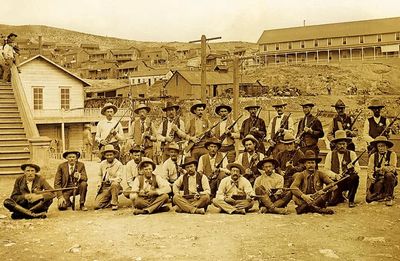
At the end of the 19th century and beginning of the 20th century, violence and criminal activity, in the form of cattle rustling, train and stagecoach robberies and killings, were rampant across the Arizona Territory. Ranch and mine owners and railroad barons were pressing for the formation of a Ranger force. They understood that if Arizona were to ever become a State in the Union, getting control over the violence was needed.

1901-1909
The approval to organize a company of Arizona Rangers arrived in the form of a bill approved in 1901 by the twenty-first Arizona Legislative Assembly. The Territorial Governor, Nathan Oakes Murphy, succeeded in not only getting the legislature to authorize the force but also in getting the funding to support it.
On March 21, 1901, the legislative act became effective, authorizing the company of Rangers, modeled after the Texas Rangers, made up of fourteen (14) men; one Captain hired at $120.00 per month, one Sergeant hired at $75.00 per month, and twelve (12) Privates hired at $55.00 each per month.
The Arizona Rangers were created to deal with the infestations of outlaws, especially rustlers, in the sparsely populated Territory of Arizona, especially along the Mexican border. They were an elite, well-trained, and initially undercover operation mounted on the best horses money could buy and equipped with the most modern weapons of the time. They were very effective in apprehending members of outlaw bands, often surprising them by descending on them without warning.
On August 30, 1901, Burton C. Mossman of Bisbee, Arizona, became the first Captain of the Arizona Rangers. He established the Ranger headquarters in Bisbee. Mossman, who had previously been superintendent of the two-million-acre Aztec Land & Cattle Co. spread, also called the "Hash Knife outfit" in northern Arizona near Holbrook and Winslow, had significant success in controlling rustling of his company's cattle. He spoke Spanish, was an excellent horseman, and a great storyteller.
In July 1902, after successfully recruiting and organizing the original Arizona Rangers, capturing and killing several outlaws, and starting to clean up the Territory, Mossman resigned, returning to the cattle & meat business.
The second Captain of the Arizona Rangers was Thomas Rynning, who had been enlisted in the Eighth Cavalry and also rode with Teddy Roosevelt's Rough Riders. He had been building railroad bridges for the Southern Pacific before joining the Arizona Rangers. In an effort to follow the criminal activity, Rynning moved to the Ranger Headquarters in Douglas.
Badges of the Arizona Rangers were first issued in 1903 under Rynning's command. They were solid silver five-pointed ball-tipped stars, lettered in blue enamel, with engravings etched in blue. An officer's badge was engraved with the rank, while badges for enlisted men were numbered. Upon resignation, a Ranger returned his badge, which was then available to be assigned to a new Ranger.
In March 1903, the authorized force was increased to 26 men (1 Captain, 1 Lieutenant, 4 Sergeants, and 20 Privates). The Rangers, many of whom in the early years were veterans of Teddy Roosevelt's Rough Riders, were skilled horsemen, trackers, and marksmen. With his army background, Rynning initiated a thorough training program with the Rangers.
The Rangers also found themselves assisting in several labor disputes. The first major incident was at the copper mine in Morenci. Due to unequal treatment and lower wages of the non-American miners, fearing violence, the Governor (Brodie) ordered all the Rangers to Morenci. Major violence was averted, and a settlement reached. This is the only documented time that 25 of the 26 Rangers were present at the same time at the same location.
In addition to dealing with rustlers and other outlaws, the Rangers were called on to deal with their second major labor dispute at a mine in Cananea, in Sonora, Mexico. This dispute turned into a full-fledged riot, resulting in many injuries and several deaths. Contemporary news reports in the New York Times on June 3, 1906, reported that on June 1, 1906, strikers destroyed a lumber mill and killed two brothers who were defending the mine.
Responding to a telegraphed plea from Colonel William Green of the Green Consolidated Copper Company, a posse of 275 volunteers from Bisbee, Douglas, and Naco, Arizona, led by Captain Thomas H. Rynning, entered Mexico against the orders of Joseph Kibby, Governor of Arizona Territory, but at the invitation of Rafael Yzabel, the Governor of Sonora, where they reinforced the Mexican rurales under Colonel Kosterlitzky. According to Colonel Green, the trouble was incited by a socialist organization that had been formed in Cananea by malcontents opposed to the Diaz government. Between the Ranger-led posse and the Mexican rurales, the riot was "put down" after several were killed and many were injured.
1957-2026 PRESENT
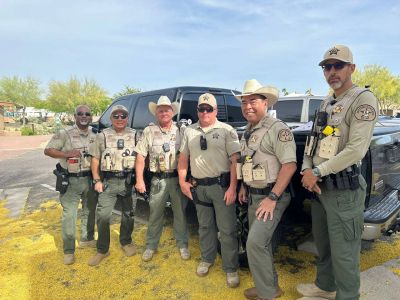
The modern-day Arizona Rangers derive and trace their lineage to the Arizona Rangers of 1901 - 1909. They were re-established in 1957 by a few surviving members of these original Arizona Territorial Rangers.
The present-day Arizona Rangers were officially recognized by the State of Arizona in 2002, when Arizona Governor Jane Hull signed Legislative Act 41. The purpose of this act was "to recognize the Arizona Rangers, who formed in 1901, disbanded in 1909, and were reestablished in 1957 by the original Arizona Rangers."
The Arizona Rangers operate throughout the State of Arizona through twenty-three satellite companies, which are the equivalent of separate posts of the same organization. The Companies are known by the name of the organization and the geographical areas from which a particular Company draws its members. For example, the Company primarily based in the Tucson area, is known as the Arizona Rangers - Tucson Company.
Today's Arizona Rangers receive extensive training and are well prepared to assist and supplement law enforcement when called upon.
Over the years, several movies were made with some portrayal and/or representation of the Arizona Rangers, including Arizona Ranger, a low-budget black-and-white film produced by RKO, released in 1948, starring Jack Holt and his son Tim Holt. Also, 26 Men, an ABC television Western, was created in 1957 based on the true exploits of the adventures of the Arizona Rangers. It starred Tris Coffin as Captain Thomas Rynning.
The Arizona Rangers were featured in the song, Big Iron, in western singer Marty Robbins' album Gunfighter Ballads and Trail Songs.
At the time the modern-day Arizona Rangers were formed, all living members of the Arizona Territorial Rangers were designated members for life of the modern-day Arizona Rangers. The last surviving Arizona Territorial Ranger, John R. Clarke, died in 1982 at the age of 97.